Select Language:

Powered By google
Showing posts with label urban. Show all posts

Tuesday, September 7, 2010

Iguazú city

The City

A good reccomendation would be to leave the falls for last, as they're so breath-taking that nothing else will seem as beautiful as they really are.
Puerto Iguazú is an awe-inspiring place. Located in the triple border of South America, this place offers loads of beautiful settings and a mix of fauna and flora it's difficult to find anywhere else.

The city buildings are no taller than a one story house, creating an atmosphere of a quite place and always giving you a very relaxing view of its clear skies.
Also, it makes it easier to see when there might be a storm coming.

Take a pair sandals with you!
If you ever get caught by rain, do not disspair as tropical rain is not cold at all and not even the temperature goes down.
Beware that the streets get incredibly flooded so if you get caught in the middle of a storm you can either wait untill it stops (wich is not really reccomended as tropical storms can last quite long) or you can simply start crossing roads as if they were short-depth rivers.

Even if you decide to go in June/August wich are the coldest months in Argentina, you'll have to put up with almost 27ºC almost everyday. Like I said, rain doesn't change temperature.


Althought it's not really the tempratures you should be aware of over there, it's the humidity in the air.
If you search for forecasts of the area before going there to know what to pack, don't waste your time because temperatures will be the same as in Buenos Aires (normal winter temperatures).


But it's the humidity that adds to a good 25ºC or 27ºC celsius degrees.
The soil of this province is not brown as it is anywhere else, it's red, due to the high content of iron in the ground.

Structure
One important characteristic of this city are its hills.
In general Argentina's cities are situated in flat lands.
But Puerto Iguazú is a clear exception to this, having hills everywhere and making going anywhere a really difficult and tiring task at the beggining.
As an Argentinian brought up in the most flatened flatness of Buenos Aires I found the city a hell in that sense.
But the English side of the story didn't find it strange nor uncomfortable.

Anwyay, there's always a bus that can take you anywhere you need.
The city is not big at all. But it is bigger than a map of it might make you think.


You'll see everything is different over there and even the simplest thing will look wildly tropical.
The redness of the soil, the incredible size of the grass and the leaves of the trees, the streets made of thin triangular black stones, the constant warm air...


Facilities

This city is more than used to European tourists and so they have all the facilities you might need.

It's easy to get anywhere and most important of all: you CAN get anywhere you need.

There's more than plenty of places to stay, anywhere you want to stay in the area. From the city center to close to the Falls, adn even inside the Falls Park!

There will always be a bus to anywhere you need to go...unlike other parts of Argentina.


Eating

Also, restaurants offer "tourist menus" for those who want to make the most out of every penny and are not on a luxurious holiday.

The main street has a various display of restaurants for all tastes and budgets.

Friday, September 3, 2010

That Hug

An image can describe things better than a million words. And it’s precisely an image what made me write this. Or more like a series of images, that would make anyone’s heart stop for a minute, especially in this times when another World Cup is being held.

Together, this pictures constitute an incredible mix of historic witness, artistic work, and naked humanity, and this has won “El abrazo del alma” (as this series of photographs have been named) many awards. Roughly translated it means “The Hug from the Soul” and just yesterday it was their 32nd anniversary.

32 years ago, yesterday, Argentina won its first ever World Cup, in 1978. With a chaotic background of the most bloody military regime South America has ever seen; fear, ignorance, passion, anxiousness, and loads of other feelings only people who lived it can express, Argentina was achieving the national dream, a tiny little bit of fake fresh air our suffocated society needed to stay alive for a bit longer.

Here I leave you the impressive shots and hope you like them. Below, there’s the short story behind them.

25th June 1978. River Plate’s football stadium. Argentina has just become World Champion for the first time. Seconds after the referee calls the end of the match.

Tarantini, one of the Argentinean players lets himself fall on the pitch and starts crying. Fillol, the goalkeeper, goes up to him to share the same feeling and kneels next to him to put their arms around each other.

A young fan whom had been hiding for an hour before the end of the match, comes running towards them. He wants to share this glorious moment with his idols. They’ll never be so close to him again, and only God knows how long will it take for these circumstances to repeat themselves.

But he’s got no arms.

He himself recalls it: “I saw the players right there, so close to me…they held each other, so I had to stop. And right then the sleeves of my blazer went forward and rested on both their backs. That’s when Alfieri took the picture and it looks as if the three of us were holding”

Victor Nicolás Dell’Aquilla was 22 at that time, and he had lost his arms during his childhood after an accident with an electrical post.

Pictures by Ricardo Alfieri (Senior) for the classical Argentinean sports magazine “El Gráfico”.

Thursday, September 2, 2010

The Obelisco


The Obelisco is a monument present in so many postards of Buenos Aires, that it had to be inlcuded here.

It is a 68 meter tall obelisk shaped monument, built for the 400th anniversary of Buenos Aires.


It's located in the middle of 9 de Julio Avenue, the widest in Latin America.

It was built by a German company in only 31 days and it required the demolition of the church located in the spot.

The location was chosen after this church being the first place in which the Argentinian flag was ever waved.
It might seem as its head has the shape of a pointy piramyd but its top is actually blunt and has a lightning conductor.

Just as Plaza de Mayo is used for political manifestations, the Obelisco is used for artistical pourposes.


A few years ago, it was covered in a pink rubber condom to commemorate AIDS day.

La Boca

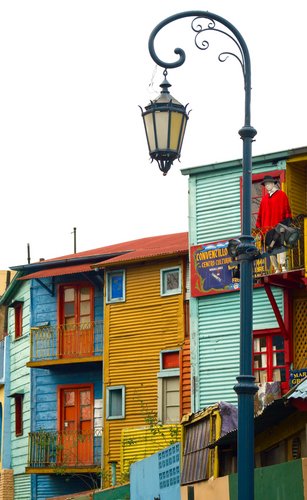
La Boca is a picturesque neighbourhood of Capital Federal in the border with Greater Buenos Aires and it's the place most linked to Tango in the world.

There are no subway stations in this area, you can only take local buses and it's very convenient that you ask the bus driver to tell you where to get off.

He will probably leave you about 2 blocks away or maybe closer, which will give you a good opportunity to see what the area is like.

Boca Juniors' Stadium is located here, and guided tours are offered.
About La Boca

La Boca was always a low class neighbourhood: First a port, then an immigrants' spot, and now simply low class but touristy.

The coulourful houses you find here are not currently inhabited, they're just real size monuments of past times. Although some are used as shops or museums.

These houses were built on high pillars due to the common floods, and one house could be shared by many families at the same time. This time of buildings were called "Conventillos".

The most famous person that represents La Boca is painter Benito Quinquela Martín whose pictures describe the port life of the neighbourhood in the early 1900's.


A block or so away from Boca Juniors Stadium and right in front of the river, there's Quinquela Martín's museum.

His pictures are unique.

La Boca is full of touristy shops, cafes and restaurants, which tend to have touristy prices as well, what in Argentina means double price.

In La Boca everyone shouts at people who walk past, advertising their shop. Here you can find, clothes' shops, souvenirs' stores, restaurants, cafes, cd stores, neighbourhood-dedicated museums...Many of these are inside the colourful buildings.

There are also many "tango dancers" in the streets of La Boca.

This people generally just stand there asking people if they'd like to a picture with them (which of course you have to pay for) but they're hardly ever dancing though.
The streets of La Boca are only for pedestrians. Cars are not allowed, so you can walk freely all along and across La Boca enjoying the view without worrying.


important!   If walking randomly down its characteristic colourful streets leads you up a dangerous area, the neighbours of La Boca will warn you and barely let you keep going any further.


Saturday, August 28, 2010

Religion

The official religion in Argentina is Roman Apostolic Catholicism. The Constitution states that a non Roman Catholic person cannot be elected president.
(There have been cases of blatant candidates followers of other religions who have converted shortly before elections)
Nevertheless, the growing religions in Argentina are the other different branches of Christianism such as Mormons, 7th Day Church, and others.

There is a huge modern movement taking part in many countries in the world, with its headquarters in Brazil (where it originated) called “Stop Suffering”, but they’re commonly referred to as “the church of the Brazilian priests”.
They’re not based on anything different to Catholicism but their distinctive factors are that they include “white” magic as part of their teachings and that they sell products to people during mass. Part of Christ’s toe, holy water from Turin in a plastic bottle and other things, are in their catalogue for sure.

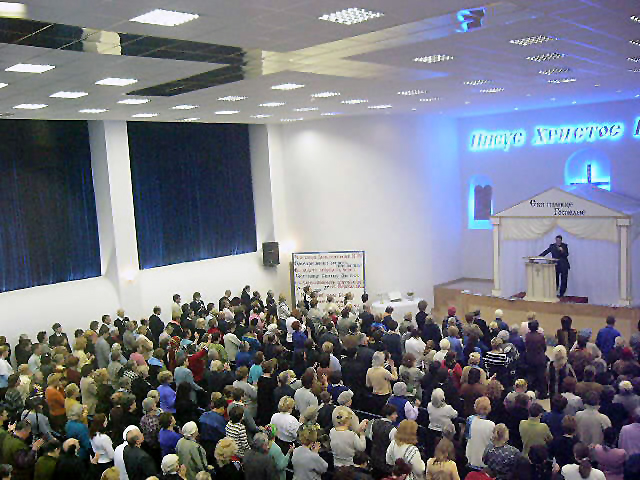
As incredible as it sounds, the “Stop Suffering” church is a non-stop growing phenomenon that owns TV and radio station all across the world, and builds the most luxurious “temples” with the latest technology and comfortable cinema seats for mass.


Still, the church can be very influential in Politics, and that’s the reason why abortion is not legal in any case in Argentina, and the “Day After” pill was only approved recently. Also, judges (who have unlimited power in Argentina) and many politicians tend to have strong Catholic beliefs which makes that influence even stronger.

This doesn’t mean they’re the only ones against this sort of laws. There is a huge part of society that doesn’t even tolerate gay people and call it a disease because “they’re not following God’s command”.

This can be ironic, since Buenos Aires is the only city in the world that has been chosen, twice in a row, the best Gay city in the world. (That statistic takes into account spots and things to do, not amount of gay people)

But then again, Argentina is a very segregated country, even though it’s only divided in two parts socially speaking. But this point is proved by the denominations we give to those parts: Buenos Aires and Interior which represents just “the whole rest of the country”.

Going back to religion, Christianism is something taken for granted in most cases, and it can even be something unconscious that people just do.

All the different stages, in a Christian’s life are celebrated just as another birthday in Argentina. Baptisms, communions and the rest, all include party, presents, family reunion, special clothes, and sometimes even renting a special place.

A typical thing to see in many houses in Argentina, are the pictures of the children of the house taking communion, hanging from the walls. And they’re generally never removed, even after those “kids” have got married.

The last two things to say about religion in Argentina are both connected to the same thing: People’s devotion in their own special way.
What most people tend to do in Argentina is choose a specific Saint or Virgin and become its “devoto”, a faithful servant. That’s the reason people don’t go to church, because as long as they pay obedience to their specific saint or Virgin they know they don’t need to do anything else.
The reasons for which to choose their Saint/Virgin are various, it can be the day of their birth being the day of that Saint, or even just the fact that they are devoted only to the Saint of whatever it is they need.

The most popular Saints and Virgins are: San Cayetano (Saint Patron of Work), Virgen Desatanudos (Virgen that unties knots, meaning that solves complicated times) and the Virgen of Luján (Virgen of Argentina).


Also, people tend to create Saints to be devoted to, from so called martyrs to urban legends to famous people that have died tragically, especially singers. 
                                                                                                             

The ways in which people show their devotion to their Saint or Virgin go from home “rituals” (lighting a candle, have a little altar, decorative religious statues) to peregrinations across very long distances.

The ways in which people show their devotion to their Saint or Virgin go from home “rituals” (lighting a candle, have a little altar, decorative religious statues or get a tattoo) to peregrinations across very long distances.


Friday, August 27, 2010

music


Argentina from most aspects is nothing but a big mix of different cultures, and its music is certainly not the exception.
However, all this mix is spiced up a little bit and so transformed into what makes it ours.

This is what makes Argentinian music very different from Latin American music, and hence has given our bands and various artists international fame.

However, modern Argentinian music didn't actually take off until the late 80's or early 90's.
Before this(60's and 70's), it was european and american artists who'd flood the markets and radios with their music, and of course there's always the local artists trying to impersonate the big foreign bands.
Even previous to those days (30's-50's), Tango had taken over everyone and everything, and before Tango, it was Old European minuets and walz.

This is what makes Argentinian music very different from Latin American music, and hence has given our bands and various artists international fame.

However, modern Argentinian music didn't actually take off until the late 80's or early 90's.

Before this(60's and 70's), it was european and american artists who'd flood the markets and radios with their music, and of course there's always the local artists trying to impersonate the big foreign bands.

Even previous to those days (30's-50's), Tango had taken over everyone and everything, and before Tango, it was Old European minuets and walz.

But it was in the late 80's/ early 90's that Argentinian bands broke the mold of Latin American music which consists generally of dramatic solos, like ballads, and decided to include various rythms of different cultures and so come up with our own national style.

Jazz, reggae, blues, flamenco, rock, ska and other styles were mixed between each other, and with our language and culture to create what's known in Latin America as Argentinian Rock. This was one of the first countries in Latin America, if not the first, to "export" our music to the rest of the continent.

Most Argentinians say that the peak of our Rock has passed though, as now the markets are more invaded of American bands and not long-lasting artists.