Select Language:

Powered By google
Showing posts with label transport. Show all posts

Monday, September 6, 2010

Iguazú: things to do


The most important thing to know about Puerto Iguazú is that the Iguazú Falls even though they are more than awe-inspiring and breathtaking, they are not the only thing in the city.
Of course, they will be the peak of your staying there, so I would suggest you go there the last. But it's just a suggestion.


Triple Border

One of the most beautiful places Puerto Iguazú has-specially during sunset-is the Triple Southamerican Border.

It is exactly where Paraguay, Brazil and Argentina almost become one.


They are only divided by narrow river, and you can see the streest and houses in Brazil and the building in Paraguay. It's a very calm point and you can local buses take you there.
If you go during the day, you can take a 10 minute boat ride to Ciudad del Este in Paraguay, wich is- they say- a place where you can get anything for cheaper than a shilling (and those don't even exist anymore)


If you think of going ot Paraguay by bus from Puerto Iguazú, there's no other road but via Brazil. Hence, it takes longer.

Wanda Mines

The Wanda Mines are a very offered tourist service.


Despite its condition of mine, you'll see it's considered a vilage in the map.

You have to take a half an hour bus more or less, and you'll get to a sign. That's all Wanda is: a sign and a road that starts there, leading you into a tropical area.


Walking up it, you'll find the mine with time , and on your way you might run into local kids that will try selling you precious stones for very low prices.

The entrance to the mine has a fee, and you get a guided tour round it including an informative talk on the minerals they work, and a gift shop.


The stones in their gift shop are polished and have deeper colours (wich means more purity) but they probably cost 10 to 15 times more than the ones the kids outside the place sell.

The Aripuca
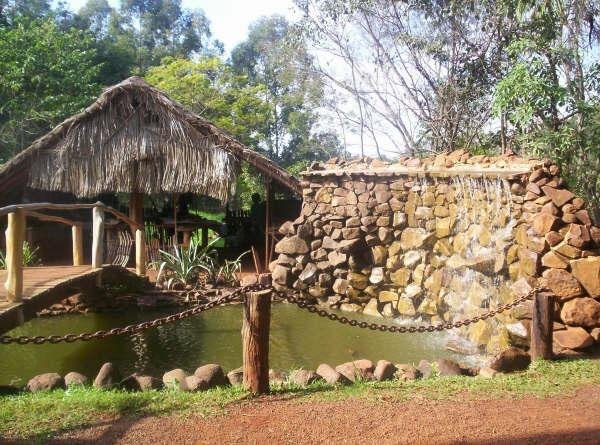
If you're looking for a very very calm place, the Aripuca is ideal. There are no sounds there, unless you ask for the paraguayan lady to play the harp for you for free.
This instrument is one of the very few sounds on Earth that can make you relax, no exception. It's even used now in spas.

The same entrance ticket can be used as many times as you like! So I'd suggest you take advantage of it.


Aripuca means "bird cage" in the local native language, and that is exactly what this place is: The biggest bird trap in the world.
But don't worry, it doens't work coz it's too big, you have stairs to go all the way up.

One activity offered in this place is bowing: a native will teach you how to shoot an arrow with a bow.


Guira Oga

If you're looking for wildlife, don't expect to find much at the Falls' Park, like I said before.
Many of the past days' common wildlife is now in danger of extintion.

However, there's Guira Oga: a natural reserve for tropical and non tropical animals.
There, you can find from toucans to eagles, to owls to carpinchos.

The carpincho is a southamerican rodent...and it's the biggest and heaviest in the world.
Still you'll see, it's very nice looking animal. It doesn not look like a rat, don't worry.

Guira Oga is a NGO, so they charge an entrance fee to support the place, its guests and staff.
It's on the way to the Falls.

The House of Bottles

Another place to visit is the House of Bottles, wich is exaclty what it's called: an entire house made out of plastic bottles.


Even it's heating sistem is made out of the same thing using a special mechanism.

It's close to the Aripuca.

Friday, August 27, 2010

music


Argentina from most aspects is nothing but a big mix of different cultures, and its music is certainly not the exception.
However, all this mix is spiced up a little bit and so transformed into what makes it ours.

This is what makes Argentinian music very different from Latin American music, and hence has given our bands and various artists international fame.

However, modern Argentinian music didn't actually take off until the late 80's or early 90's.
Before this(60's and 70's), it was european and american artists who'd flood the markets and radios with their music, and of course there's always the local artists trying to impersonate the big foreign bands.
Even previous to those days (30's-50's), Tango had taken over everyone and everything, and before Tango, it was Old European minuets and walz.

This is what makes Argentinian music very different from Latin American music, and hence has given our bands and various artists international fame.

However, modern Argentinian music didn't actually take off until the late 80's or early 90's.

Before this(60's and 70's), it was european and american artists who'd flood the markets and radios with their music, and of course there's always the local artists trying to impersonate the big foreign bands.

Even previous to those days (30's-50's), Tango had taken over everyone and everything, and before Tango, it was Old European minuets and walz.

But it was in the late 80's/ early 90's that Argentinian bands broke the mold of Latin American music which consists generally of dramatic solos, like ballads, and decided to include various rythms of different cultures and so come up with our own national style.

Jazz, reggae, blues, flamenco, rock, ska and other styles were mixed between each other, and with our language and culture to create what's known in Latin America as Argentinian Rock. This was one of the first countries in Latin America, if not the first, to "export" our music to the rest of the continent.

Most Argentinians say that the peak of our Rock has passed though, as now the markets are more invaded of American bands and not long-lasting artists.

Thursday, August 26, 2010

Moving Around

As an old Argentinian saying prays, "God is Argentinian but his office is in Buenos Aires", meaning whatever you need is in this city, and in this city only.

Buenos Aires isn't just the only city with a subway system, it's also the only connection between national flights, the most cosmopolitan city in the country and the soul of any paperwork you might ever need.

Despite this city's large extension and scattered hot spots, you'll see that transport doesn't quite cover much of the city.

The subway system covers very little terrain of the city, and doens't quite give you access to many of the main tourist spots in Buenos Aires.

Nevertheless it's the fastest and safest transport, and even a tourist attraction in itself as many stations remain untouched from the day of their construction.

There's a subway line which has a wooden interior and fancy ceiling lamps.

Getting here & Moving Around

This section might seem a little irrelevant, but I have included it as I know getting to Argentina's International Airport isn't just getting to Argentina.

This airport, the only international one in the country, as incovenient as that is, is not in Buenos Aires. It's in a nearby city called Ezeiza.

If you happen to check on flights you'll find next to the name of the Argentinian Airport, Ministro Pistarini, the word (EZE), referring to this city and not Buenos Aires.

Here's a picture where you can see Ezeiza's Airport's location, and the city of Buenos Aires.

There's only two means of transport that can take you to Buenos Aires form here: private coaches or a local bus.

Of course the private coaches are many many more times more expensive than the local bus, specially when you take into consideration there's only one company that provides this service.

The local bus is only a few coins, but it makes stops of course, and it's a public service, which means less comfort if you're a picky person.

There are no subways in this area. In fact, the city of Buenos Aires, is the only city in the country which has this mean of transport, and was actually the first in South America.