Select Language:

Powered By google
Showing posts with label info. Show all posts

Wednesday, September 22, 2010

Food. Main courses

Asado

Argentinian food is basically meat. Most dishes include meats of all types.
 
The most typical argentinian dish is asado.
Asado is charcoal-grilled beef. This cooking style is what gives asado its particular and unique taste.
It's usually advertised as Parrila or Parrillada, wich includes other parts of the cow and chicken.

For a Parrillada to be lovely -as it's supposed to be- it has be well done, respecting the cooking times. So bare in mind this means a higher price than any normal dish.
 
Therefore a good advice would be not to go for a parrillada that's cheap only because you're not sure you'll like it.
 
If it's cheap, it's probably not going to be nice and you'll get a wrong idea of what parrillada is like.


Ñoquis

Ñoquis (pronounced nee-o-keys) are a type of pasta, despite not ben cooked the same way.

Ñoquis are made out of mashed potatoes and flour, cut into pieces and then boiled.

 
It is an argentinian tradition to have ñoquis for each 29th of each month, with a peso note under the plate, to bring prosperity to who's eating.


Tuesday, September 7, 2010

Iguazú city

The City

A good reccomendation would be to leave the falls for last, as they're so breath-taking that nothing else will seem as beautiful as they really are.
Puerto Iguazú is an awe-inspiring place. Located in the triple border of South America, this place offers loads of beautiful settings and a mix of fauna and flora it's difficult to find anywhere else.

The city buildings are no taller than a one story house, creating an atmosphere of a quite place and always giving you a very relaxing view of its clear skies.
Also, it makes it easier to see when there might be a storm coming.

Take a pair sandals with you!
If you ever get caught by rain, do not disspair as tropical rain is not cold at all and not even the temperature goes down.
Beware that the streets get incredibly flooded so if you get caught in the middle of a storm you can either wait untill it stops (wich is not really reccomended as tropical storms can last quite long) or you can simply start crossing roads as if they were short-depth rivers.

Even if you decide to go in June/August wich are the coldest months in Argentina, you'll have to put up with almost 27ºC almost everyday. Like I said, rain doesn't change temperature.


Althought it's not really the tempratures you should be aware of over there, it's the humidity in the air.
If you search for forecasts of the area before going there to know what to pack, don't waste your time because temperatures will be the same as in Buenos Aires (normal winter temperatures).


But it's the humidity that adds to a good 25ºC or 27ºC celsius degrees.
The soil of this province is not brown as it is anywhere else, it's red, due to the high content of iron in the ground.

Structure
One important characteristic of this city are its hills.
In general Argentina's cities are situated in flat lands.
But Puerto Iguazú is a clear exception to this, having hills everywhere and making going anywhere a really difficult and tiring task at the beggining.
As an Argentinian brought up in the most flatened flatness of Buenos Aires I found the city a hell in that sense.
But the English side of the story didn't find it strange nor uncomfortable.

Anwyay, there's always a bus that can take you anywhere you need.
The city is not big at all. But it is bigger than a map of it might make you think.


You'll see everything is different over there and even the simplest thing will look wildly tropical.
The redness of the soil, the incredible size of the grass and the leaves of the trees, the streets made of thin triangular black stones, the constant warm air...


Facilities

This city is more than used to European tourists and so they have all the facilities you might need.

It's easy to get anywhere and most important of all: you CAN get anywhere you need.

There's more than plenty of places to stay, anywhere you want to stay in the area. From the city center to close to the Falls, adn even inside the Falls Park!

There will always be a bus to anywhere you need to go...unlike other parts of Argentina.


Eating

Also, restaurants offer "tourist menus" for those who want to make the most out of every penny and are not on a luxurious holiday.

The main street has a various display of restaurants for all tastes and budgets.

Monday, September 6, 2010

Iguazú: things to do


The most important thing to know about Puerto Iguazú is that the Iguazú Falls even though they are more than awe-inspiring and breathtaking, they are not the only thing in the city.
Of course, they will be the peak of your staying there, so I would suggest you go there the last. But it's just a suggestion.


Triple Border

One of the most beautiful places Puerto Iguazú has-specially during sunset-is the Triple Southamerican Border.

It is exactly where Paraguay, Brazil and Argentina almost become one.


They are only divided by narrow river, and you can see the streest and houses in Brazil and the building in Paraguay. It's a very calm point and you can local buses take you there.
If you go during the day, you can take a 10 minute boat ride to Ciudad del Este in Paraguay, wich is- they say- a place where you can get anything for cheaper than a shilling (and those don't even exist anymore)


If you think of going ot Paraguay by bus from Puerto Iguazú, there's no other road but via Brazil. Hence, it takes longer.

Wanda Mines

The Wanda Mines are a very offered tourist service.


Despite its condition of mine, you'll see it's considered a vilage in the map.

You have to take a half an hour bus more or less, and you'll get to a sign. That's all Wanda is: a sign and a road that starts there, leading you into a tropical area.


Walking up it, you'll find the mine with time , and on your way you might run into local kids that will try selling you precious stones for very low prices.

The entrance to the mine has a fee, and you get a guided tour round it including an informative talk on the minerals they work, and a gift shop.


The stones in their gift shop are polished and have deeper colours (wich means more purity) but they probably cost 10 to 15 times more than the ones the kids outside the place sell.

The Aripuca

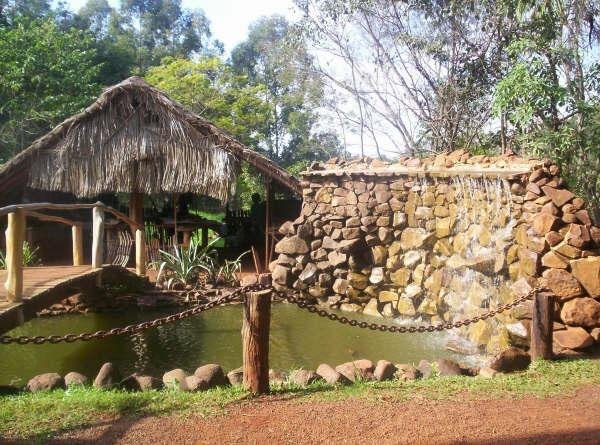
If you're looking for a very very calm place, the Aripuca is ideal. There are no sounds there, unless you ask for the paraguayan lady to play the harp for you for free.
This instrument is one of the very few sounds on Earth that can make you relax, no exception. It's even used now in spas.

The same entrance ticket can be used as many times as you like! So I'd suggest you take advantage of it.


Aripuca means "bird cage" in the local native language, and that is exactly what this place is: The biggest bird trap in the world.
But don't worry, it doens't work coz it's too big, you have stairs to go all the way up.

One activity offered in this place is bowing: a native will teach you how to shoot an arrow with a bow.


Guira Oga

If you're looking for wildlife, don't expect to find much at the Falls' Park, like I said before.
Many of the past days' common wildlife is now in danger of extintion.

However, there's Guira Oga: a natural reserve for tropical and non tropical animals.
There, you can find from toucans to eagles, to owls to carpinchos.

The carpincho is a southamerican rodent...and it's the biggest and heaviest in the world.
Still you'll see, it's very nice looking animal. It doesn not look like a rat, don't worry.

Guira Oga is a NGO, so they charge an entrance fee to support the place, its guests and staff.
It's on the way to the Falls.

The House of Bottles

Another place to visit is the House of Bottles, wich is exaclty what it's called: an entire house made out of plastic bottles.


Even it's heating sistem is made out of the same thing using a special mechanism.

It's close to the Aripuca.

Iguazú

Iguazú is the perfect place to visit a tropical rainforest without having to leave the comfort civilization gives you.
This city offers the perfect combination of modern life and natural peace.
If there's one thing this city does not lack is the presence of English tourists. So don't worry about the language as everybody speaks English -unlike other areas of Argentina.

Don't worry about people trying to rip you off for hearing your language, because just your accent will be enough in case you don't speak perfectly. Just don't take taxis and by that you'll be saving enough.

Unfortunatelly, many tourists go to this beautiful city just to take some pictures of the Falls and then leave.


But Puerto Iguazú offers incredible places and landscapes and unique experiences.

Sunday, September 5, 2010

education

In Argentina education begins at the age of 3 with kindergarten. Until a few years ago this stage was optional.


Educational stages

3-6 years old: kindergarten


6-12: primary school


12-17: secondary school

There are various types of schools in Argentina.

Private schools:

Even though they get subventions from the Government, fees are paid to attend to these schools. They are all Catholic and in most cases bilingual. Some offer “double shift” (students attend morning and afternoon, unlike public schools) Also, students are required to dress in the specific school uniform when attending these sort of schools.


Public schools:

As they get subventions from the Government, they cannot charge students. Contributions are always required though, as money is always needed.
Religion is banned from public schools as it’s understood that in their condition of public no differences should be made with students of other religions nor should any religion be imposed to anyone.
Public schools students don’t wear a school uniform, but all students of public school are required to dress in the same white lab coat. This was a law created along with schools themselves in Argentina, so as to make everyone the same, regardless age, school, province, culture, or any other difference.

Public schools work in two or three shifts, but student only attend to one. This is, morning or afternoon, or night. Night shifts are only for overage people who couldn’t graduate.

Hence, public schools students only attend school for a maximum of 5 hours.

Dinning schools:

These sort of schools are settled in poor areas where the students main aim is to have a daily meal.


As the conditions are so extreme, the educational side is left aside a bit more, and teachers focus more in supporting and helping the students.


Universities:
 
 There are two types of Universities in Argentina: public ones and private ones.


Private Universities require all sorts of fees to enter, study, sit exams and graduate. But they guarantee organisation.

Public Universities are free of any charge whatsoever and let the student take his own decisions as when to sit exams, how often, whether to attend to class or not and so on.

However, just as the student provides no security to the University, neither does the University provide any kind of good organisation. By this, I refer to random strikes, random change in exam dates, and so on.

Whether you attend a private or a public University, none offer accommodation.

Thursday, September 2, 2010

The Obelisco


The Obelisco is a monument present in so many postards of Buenos Aires, that it had to be inlcuded here.

It is a 68 meter tall obelisk shaped monument, built for the 400th anniversary of Buenos Aires.


It's located in the middle of 9 de Julio Avenue, the widest in Latin America.

It was built by a German company in only 31 days and it required the demolition of the church located in the spot.

The location was chosen after this church being the first place in which the Argentinian flag was ever waved.
It might seem as its head has the shape of a pointy piramyd but its top is actually blunt and has a lightning conductor.

Just as Plaza de Mayo is used for political manifestations, the Obelisco is used for artistical pourposes.


A few years ago, it was covered in a pink rubber condom to commemorate AIDS day.

Saturday, August 28, 2010

Religion

The official religion in Argentina is Roman Apostolic Catholicism. The Constitution states that a non Roman Catholic person cannot be elected president.
(There have been cases of blatant candidates followers of other religions who have converted shortly before elections)
Nevertheless, the growing religions in Argentina are the other different branches of Christianism such as Mormons, 7th Day Church, and others.

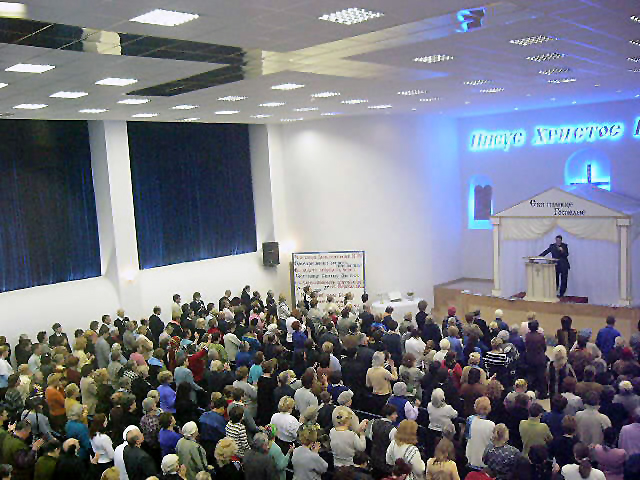
There is a huge modern movement taking part in many countries in the world, with its headquarters in Brazil (where it originated) called “Stop Suffering”, but they’re commonly referred to as “the church of the Brazilian priests”.
They’re not based on anything different to Catholicism but their distinctive factors are that they include “white” magic as part of their teachings and that they sell products to people during mass. Part of Christ’s toe, holy water from Turin in a plastic bottle and other things, are in their catalogue for sure.

As incredible as it sounds, the “Stop Suffering” church is a non-stop growing phenomenon that owns TV and radio station all across the world, and builds the most luxurious “temples” with the latest technology and comfortable cinema seats for mass.


Still, the church can be very influential in Politics, and that’s the reason why abortion is not legal in any case in Argentina, and the “Day After” pill was only approved recently. Also, judges (who have unlimited power in Argentina) and many politicians tend to have strong Catholic beliefs which makes that influence even stronger.

This doesn’t mean they’re the only ones against this sort of laws. There is a huge part of society that doesn’t even tolerate gay people and call it a disease because “they’re not following God’s command”.

This can be ironic, since Buenos Aires is the only city in the world that has been chosen, twice in a row, the best Gay city in the world. (That statistic takes into account spots and things to do, not amount of gay people)

But then again, Argentina is a very segregated country, even though it’s only divided in two parts socially speaking. But this point is proved by the denominations we give to those parts: Buenos Aires and Interior which represents just “the whole rest of the country”.

Going back to religion, Christianism is something taken for granted in most cases, and it can even be something unconscious that people just do.

All the different stages, in a Christian’s life are celebrated just as another birthday in Argentina. Baptisms, communions and the rest, all include party, presents, family reunion, special clothes, and sometimes even renting a special place.

A typical thing to see in many houses in Argentina, are the pictures of the children of the house taking communion, hanging from the walls. And they’re generally never removed, even after those “kids” have got married.

The last two things to say about religion in Argentina are both connected to the same thing: People’s devotion in their own special way.
What most people tend to do in Argentina is choose a specific Saint or Virgin and become its “devoto”, a faithful servant. That’s the reason people don’t go to church, because as long as they pay obedience to their specific saint or Virgin they know they don’t need to do anything else.
The reasons for which to choose their Saint/Virgin are various, it can be the day of their birth being the day of that Saint, or even just the fact that they are devoted only to the Saint of whatever it is they need.

The most popular Saints and Virgins are: San Cayetano (Saint Patron of Work), Virgen Desatanudos (Virgen that unties knots, meaning that solves complicated times) and the Virgen of Luján (Virgen of Argentina).


Also, people tend to create Saints to be devoted to, from so called martyrs to urban legends to famous people that have died tragically, especially singers. 
                                                                                                             

The ways in which people show their devotion to their Saint or Virgin go from home “rituals” (lighting a candle, have a little altar, decorative religious statues) to peregrinations across very long distances.

The ways in which people show their devotion to their Saint or Virgin go from home “rituals” (lighting a candle, have a little altar, decorative religious statues or get a tattoo) to peregrinations across very long distances.


Thursday, August 26, 2010

Welcome!

This website is not to promote tourism, it's simply to help anyone that might consider Argentina for anything, have an idea of the place.

This is simply information from a native, free of any catchs or anything.

You can read why I decided to make this website in the "intro" link above.

Argentina is a large country with a million different wonderful things to offer and it's a shame many people come and miss many lovely spots or don't really kow what they're seeing.

I've tried not to put many pictures I haven't taken because this is not this is not a promotion of anything...but I've had to as there are many places I haven't visited but are worth it's sections.

Some pictures here might look like they were taken from the internet or done professionaly, but they were taken by me with a 3.2 mp camera, so you can see some places are that beautiful no camera could not show that condition.