Select Language:

Powered By google
Showing posts with label buenos aires. Show all posts

Monday, June 13, 2011

Casa Rosada/The Pink House

This is commonly considered the argentinian equivalent of the White House, but in truth, it's not.

The president of Argentina does not live in the Pink House. In fact, she's hardly ever there.
This building is located at 50 Balcarce street and Paseo Colón. On the left side of the building there's the subway station called "Plaza de Mayo" (line A)

The name of the station is after the park located in front of the Pink House.

You can see this park in old films of Evita Peron's speeches, as this is where the people use to gather to face the balcony from which she used to speak.

Plaza de Mayo is the oldest park in Buenos Aires. Its name refers to the month in which the people of Buenos Aires gathered to ask for their viceroy's expulsion of the territory and so become a free country.

This was on 25th May 1810 in this very same spot.
Since then, this park has become "the place in wich the population as a whole has a voice".

This is why this is the place in which people gathered to see Evita and even asked her to become vice-president.

This park was also used by relatives of people who had dissapeared under the militar regime in the 70's, to demand for information. This people wore a characteristic white headscarf.

At the center of the park there's a 20 meter tall white needle created for the 100 anniversary of Argentina.

All around this monument, on the floor, you can see drawings of their scarfs, in commemoration to their struggle.

Friday, September 3, 2010

That Hug

An image can describe things better than a million words. And it’s precisely an image what made me write this. Or more like a series of images, that would make anyone’s heart stop for a minute, especially in this times when another World Cup is being held.

Together, this pictures constitute an incredible mix of historic witness, artistic work, and naked humanity, and this has won “El abrazo del alma” (as this series of photographs have been named) many awards. Roughly translated it means “The Hug from the Soul” and just yesterday it was their 32nd anniversary.

32 years ago, yesterday, Argentina won its first ever World Cup, in 1978. With a chaotic background of the most bloody military regime South America has ever seen; fear, ignorance, passion, anxiousness, and loads of other feelings only people who lived it can express, Argentina was achieving the national dream, a tiny little bit of fake fresh air our suffocated society needed to stay alive for a bit longer.

Here I leave you the impressive shots and hope you like them. Below, there’s the short story behind them.

25th June 1978. River Plate’s football stadium. Argentina has just become World Champion for the first time. Seconds after the referee calls the end of the match.

Tarantini, one of the Argentinean players lets himself fall on the pitch and starts crying. Fillol, the goalkeeper, goes up to him to share the same feeling and kneels next to him to put their arms around each other.

A young fan whom had been hiding for an hour before the end of the match, comes running towards them. He wants to share this glorious moment with his idols. They’ll never be so close to him again, and only God knows how long will it take for these circumstances to repeat themselves.

But he’s got no arms.

He himself recalls it: “I saw the players right there, so close to me…they held each other, so I had to stop. And right then the sleeves of my blazer went forward and rested on both their backs. That’s when Alfieri took the picture and it looks as if the three of us were holding”

Victor Nicolás Dell’Aquilla was 22 at that time, and he had lost his arms during his childhood after an accident with an electrical post.

Pictures by Ricardo Alfieri (Senior) for the classical Argentinean sports magazine “El Gráfico”.

Thursday, September 2, 2010

The Obelisco


The Obelisco is a monument present in so many postards of Buenos Aires, that it had to be inlcuded here.

It is a 68 meter tall obelisk shaped monument, built for the 400th anniversary of Buenos Aires.


It's located in the middle of 9 de Julio Avenue, the widest in Latin America.

It was built by a German company in only 31 days and it required the demolition of the church located in the spot.

The location was chosen after this church being the first place in which the Argentinian flag was ever waved.
It might seem as its head has the shape of a pointy piramyd but its top is actually blunt and has a lightning conductor.

Just as Plaza de Mayo is used for political manifestations, the Obelisco is used for artistical pourposes.


A few years ago, it was covered in a pink rubber condom to commemorate AIDS day.

La Boca

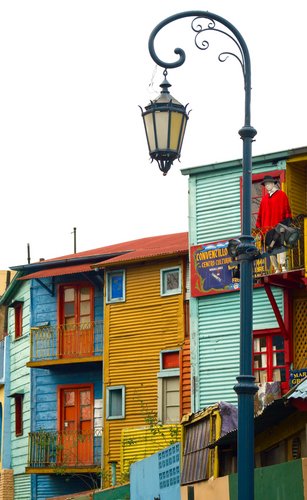
La Boca is a picturesque neighbourhood of Capital Federal in the border with Greater Buenos Aires and it's the place most linked to Tango in the world.

There are no subway stations in this area, you can only take local buses and it's very convenient that you ask the bus driver to tell you where to get off.

He will probably leave you about 2 blocks away or maybe closer, which will give you a good opportunity to see what the area is like.

Boca Juniors' Stadium is located here, and guided tours are offered.
About La Boca

La Boca was always a low class neighbourhood: First a port, then an immigrants' spot, and now simply low class but touristy.

The coulourful houses you find here are not currently inhabited, they're just real size monuments of past times. Although some are used as shops or museums.

These houses were built on high pillars due to the common floods, and one house could be shared by many families at the same time. This time of buildings were called "Conventillos".

The most famous person that represents La Boca is painter Benito Quinquela Martín whose pictures describe the port life of the neighbourhood in the early 1900's.


A block or so away from Boca Juniors Stadium and right in front of the river, there's Quinquela Martín's museum.

His pictures are unique.

La Boca is full of touristy shops, cafes and restaurants, which tend to have touristy prices as well, what in Argentina means double price.

In La Boca everyone shouts at people who walk past, advertising their shop. Here you can find, clothes' shops, souvenirs' stores, restaurants, cafes, cd stores, neighbourhood-dedicated museums...Many of these are inside the colourful buildings.

There are also many "tango dancers" in the streets of La Boca.

This people generally just stand there asking people if they'd like to a picture with them (which of course you have to pay for) but they're hardly ever dancing though.
The streets of La Boca are only for pedestrians. Cars are not allowed, so you can walk freely all along and across La Boca enjoying the view without worrying.


important!   If walking randomly down its characteristic colourful streets leads you up a dangerous area, the neighbours of La Boca will warn you and barely let you keep going any further.


Thursday, August 26, 2010

Moving Around

As an old Argentinian saying prays, "God is Argentinian but his office is in Buenos Aires", meaning whatever you need is in this city, and in this city only.

Buenos Aires isn't just the only city with a subway system, it's also the only connection between national flights, the most cosmopolitan city in the country and the soul of any paperwork you might ever need.

Despite this city's large extension and scattered hot spots, you'll see that transport doesn't quite cover much of the city.

The subway system covers very little terrain of the city, and doens't quite give you access to many of the main tourist spots in Buenos Aires.

Nevertheless it's the fastest and safest transport, and even a tourist attraction in itself as many stations remain untouched from the day of their construction.

There's a subway line which has a wooden interior and fancy ceiling lamps.

Getting here & Moving Around

This section might seem a little irrelevant, but I have included it as I know getting to Argentina's International Airport isn't just getting to Argentina.

This airport, the only international one in the country, as incovenient as that is, is not in Buenos Aires. It's in a nearby city called Ezeiza.

If you happen to check on flights you'll find next to the name of the Argentinian Airport, Ministro Pistarini, the word (EZE), referring to this city and not Buenos Aires.

Here's a picture where you can see Ezeiza's Airport's location, and the city of Buenos Aires.

There's only two means of transport that can take you to Buenos Aires form here: private coaches or a local bus.

Of course the private coaches are many many more times more expensive than the local bus, specially when you take into consideration there's only one company that provides this service.

The local bus is only a few coins, but it makes stops of course, and it's a public service, which means less comfort if you're a picky person.

There are no subways in this area. In fact, the city of Buenos Aires, is the only city in the country which has this mean of transport, and was actually the first in South America.